Hedonism 2026
Four philosophical lenses on Compass Box's most indulgent annual release
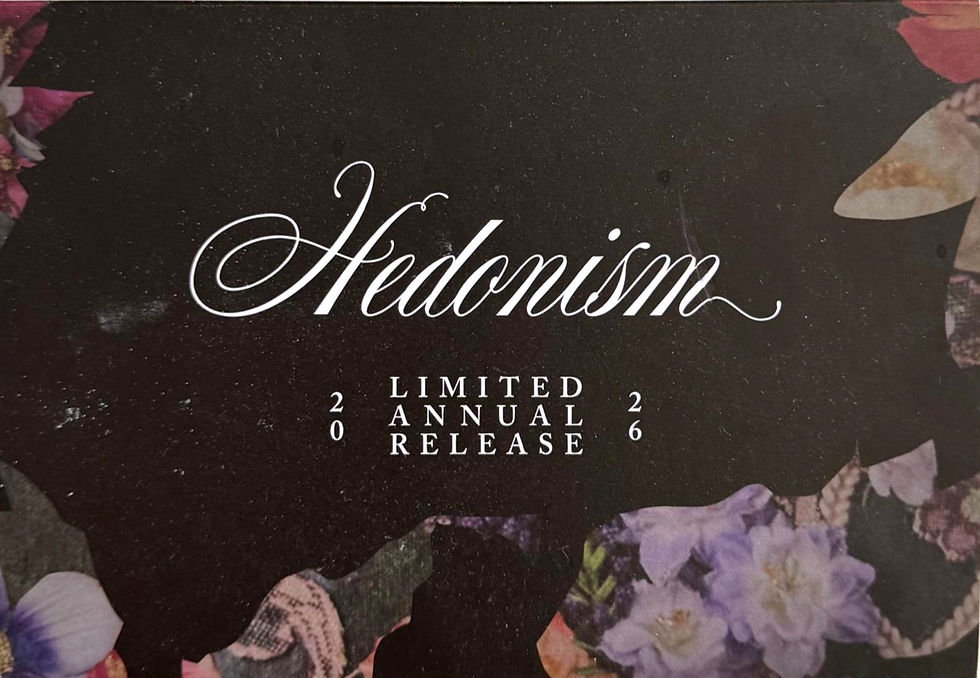
The box it arrived in was covered in cursive writing, flowers and art, reflecting the style of the dram inside. During my Masters in marketing, hedonism in consumer behaviour came up as I was researching my thesis on how much we attach our personality to our favourite bottle of whisky. This year's limited release made me think — and I decided to look past the tasting notes and apply a researched lens to the drink itself.

I - Qualitative Hedonism

The superiority of grain
Qualitative hedonism is all about creating meaning and superior experiences. When you think about this in a whisky context and specifically the Compass Box Limited Release, it basically challenges the quantity versus quality myth. Grain whisky has always been the "workhorse" of the whisky industry. It was meant to fill the casks and create more volume; however, taking into account qualitative hedonism, which was coined by John Stuart Mill, it provides a perfect defense for what Compass Box has actually achieved with their limited releases.
The inclusion of 30-year-old Strathclyde parcels replaces the aggressive 'punch' of standard grain whiskies with a sophisticated, silky texture, which offers a "higher pleasure".
II - Neo-hedonism
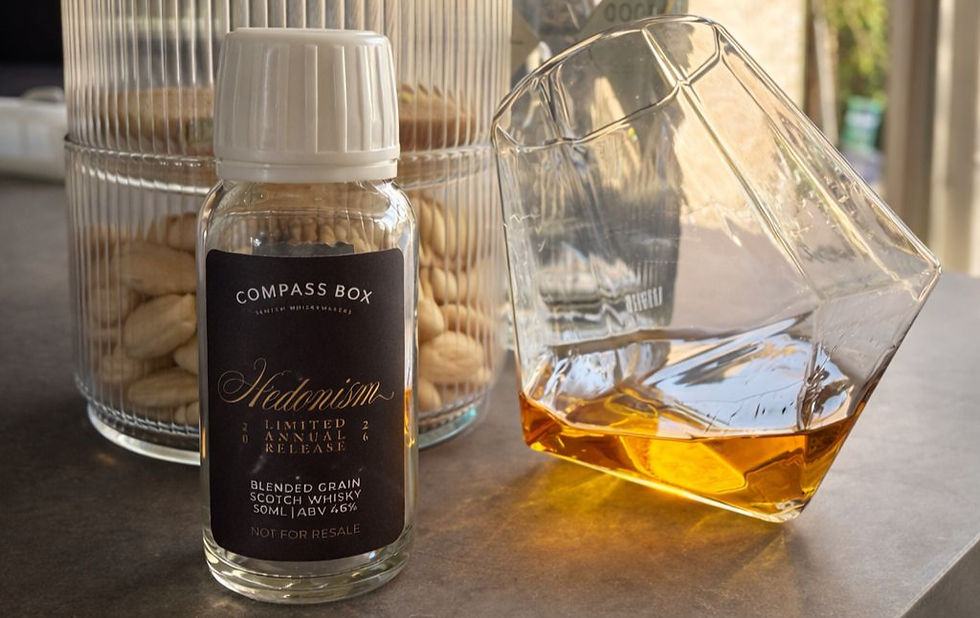
The luxury of fleeting
As consumer behaviour changes so too has hedonism and we are currently seeing a new version called Neo-hedonism. Contemporary hedonism has shifted from excess to authenticity, uniqueness, and rarity. When you realise that the stocks of 20th century grain whiskies are finite, as Master Blender Angela D'Orazio has pointed out, you realize that what Compass Box has created is not a recipe that can be repeated.
"You can consider this a moment in a bottle — a feeling of luxury that is both timeless and fleeting at the same time."
— On the 2026 Hedonism release
Considering that the next generation of whisky drinkers will be looking for those unique whiskies and new and innovative ways to experience pleasure, releases like Hedonism, with its unique character and design, epitomise the concept of Neo-hedonism.
III - Domestic hedonism

The sanctuary of the glass
You may have heard of this version of hedonism in the past however domestic hedonism really started to take form during the pandemic, when we were all forced to sit at home and where we discovered the delights of becoming a home bartender or online shopping. In a way, we were all escaping the realities of a world that was locked down. Now that the doors have been opened again, you could consider domestic hedonism and your home as the ultimate location for your sensory pleasure.
You don't have to go out into a bar to experience true pleasure. Hedonism 2026 gives you that feeling of being at home in the morning with its creamy notes of cafe latté and butterscotch. If you close your eyes and inhale deeply and enjoy this whisky, you might consider yourself a nesting connoisseur, encouraging you to consume slowly and enjoy that personal sanctuary that is your home. You can turn that simple evening into a warm and decadent moment of luxury.
IV - Hedonic Escapism

The gateway to tasting
Hedonic escapism is all about going beyond the passive consumption. It's about self-expansion, the idea that a luxurious experience is not just something you buy but it is something that you add onto who you are. Like Karen Gillan, whom Compass Box embraced as this year's muse, you too could, through hedonic escapism, step outside of your everyday self. You could be more than just the employee or the parent.
Going beyond that passive consumption - drinking to forget - you start to drink to discover and to feel. The complexity of the 2026 release demands your active attention so you can find those notes of sherry, cream, oak and fruit. Emma Hack's artwork provides us a visual narrative that allows you to enter into the world of hedonism. Taking in the beautiful designs, you could actually experience so much more than drinking a whisky. Instead, you are consuming a curated piece of art.
TASTING NOTES - COMPASS BOX HEDONISM 2026 | |
NOSE Café latte, butterscotch, soft vanilla, a hint of toasted oak | PALATE Sherry, cream, fruit cake, gentle spice, silky grain texture |
FINISH Long, warm, sweet oak... lingers beautifully | STYLE Blended Grain, Limited Annual Release |
DISTILLER Compass Box — Master Blender Angela D'Orazio | AVAILABILITY Limited |
SOURCES AND FURTHER READING
Bacardi Limited. (2021, January 14). From domestic hedonism to mindful moderation: The Bacardi survey reveals spirits trends sparked by cultural shifts last year. Bacardi Limited. https://www.bacardilimited.com/media/news-archive/from-domestic-hedonism-to-mindful-moderation-the-bacardi-survey-reveals-spirits-trends-sparked-by-cultural-shifts-last-year/
Brink, D. O. (1992). Mill's deliberative utilitarianism. Philosophy & Public Affairs, 21(1), 67–103. https://www.utilitarianism.com/hedonism-utilitarianism.pdf
Canopy. (n.d.). Consumers seek maximum reward: The evolution of modern hedonism. International Wine Challenge. https://www.internationalwinechallenge.com/Canopy-Articles/consumers-seek-maximum-reward.html
Crisp, R. (1997). Mill on utilitarianism. Routledge. [Original work published 1861 by J.S. Mill].
Holmqvist, J., Diaz Ruiz, C., & Peñaloza, L. (2020). Moments of luxury: Hedonic escapism as a luxury experience. Journal of Business Research, 116, 503–513. https://doi.org/10.1016/j.jbusres.2019.10.015
Kushlev, K., & Dunn, E. W. (2023). Escape from self: Stress increases consumers' preference for experiences over material possessions. Journal of Consumer Psychology. https://pmc.ncbi.nlm.nih.gov/articles/PMC9851043/
Macleod, C. (2023). John Stuart Mill: Ethics. In Internet Encyclopedia of Philosophy. https://iep.utm.edu/mill-eth/
Purba, P. S., & Puspitasari, D. (2020). Hedonism on the behavior of consumer society as a global cultural transformation. Journal of Social Science and Humanities. https://www.researchgate.net/publication/340259851_Hedonism_on_the_behavior_of_consumer_society_as_a_global_cultural_transformation
Saunders, B. (2010). A defence of Mill's qualitative hedonism. Philosophy, 85(331), 51–78. https://www.cambridge.org/core/journals/philosophy/article/defence-of-mills-qualitative-hedonism/952713A54E7E6480659283AD05AAA3EE
Soper, K. (2008). Alternative hedonism: A theory and politics of consumption. KTH Royal Institute of Technology. https://www.kth.se/polopoly_fs/1.197994.1600688811!/Menu/general/column-content/attachment/althedonism%5B1%5D.pdf
Stenseng, F., Rise, J., & Kraft, P. (2012). Activity engagement as escape from self: The role of self-suppression and self-expansion. Leisure Sciences, 34(1), 19–38.
Xie, C., & Zhang, J. (2021). The sources and influencing factors of hedonistic consumption. American Journal of Industrial and Business Management, 11(5), 450–461. https://www.scirp.org/journal/paperinformation?paperid=108876



Comments